
Ditch to Ditch: The Cooperative Ecology of Prescribed Fire on the Prairie
August 20, 2026
Tobi Oyedele, Canadian Prairies Prescribed Fire Exchange
When most people look across a rural concession road, they see a simple boundary: a barbed-wire fence separating one parcel of pastureland from another, sometimes flanked by a drainage ditch. But for a growing network of agricultural producers, conservationists, volunteer fire fighters and researchers across the Canadian Prairies, that space represents something much larger. It represents a canvas for ecological restoration, cooperative land management, and a powerful tool that has been largely absent from our landscape for generations; fire.
Bringing prescribed fire back to the prairie is not a one-person task. It requires meticulous planning, a deep understanding of complex ecological interactions, and, above all, neighbors working together from ditch to ditch.
The Anatomy of a Burn
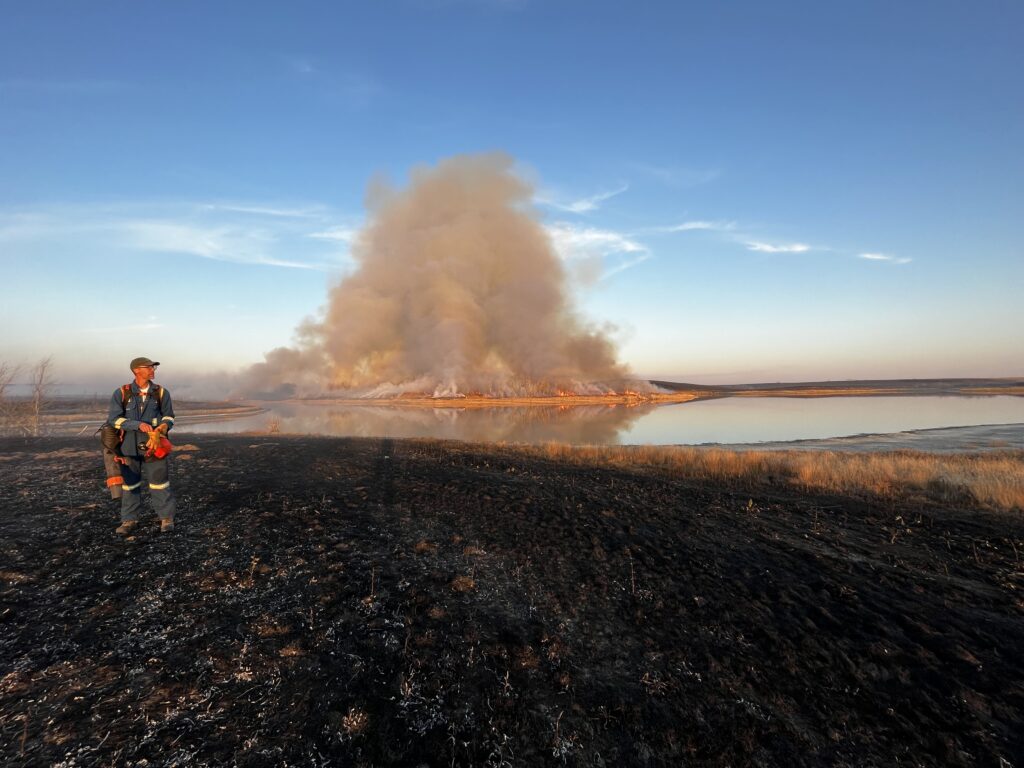
Executing a prescribed fire is an exercise in applied science and operational planning. Long before a single match is lit, months of preparation take place from parcel planning to the fireline. Securing a parcel to burn involves drafting comprehensive burn plans that account for local fuel loads, historical weather patterns, topography, and strict containment strategies.
Foundational research by local experts like Dr. Dale Gross and Dr. Eric Lamb has long emphasized that understanding the spatial and temporal effects of burning is critical to managing plant community composition and successfully reintroducing fire into native fescue grassland ecosystems (Gross & Romo, 2010; Gross, 2023). Decades of fire suppression have allowed native and tame grasslands alike to accumulate dense grass litter / thatch, which chokes out plant diversity, reduces forage quality for livestock, and increases the risk of uncontrollable wildfires. Prescribed fire resets this ecological clock, cycling nutrients back into the soil, stimulating dormant seed banks, and enhancing overall ecosystem resilience (Lamb et al., 2023).
The Power of Community Prescribed Burn Associations
Fire stewardship on the prairies is inherently communal. When multiple landowners pool their resources, heavy equipment, and local knowledge, barriers to entry drop significantly. Grassroots prescribed burn associations (PBAs) and neighbor-led cooperatives allow producers to share the heavy lifting of fireline preparation, ignition execution, overnight patrol duties, and post-burn monitoring.
This collaborative model effectively bridges the gap between complex scientific research and practical, boots-on-the-ground agriculture. Industry leaders like Renny Grilz, PAg have long emphasized that returning fire to the landscape is fundamentally about building trust, sharing liability, and forging lasting partnerships among rural communities (Grilz, 2026). When neighboring farmers coordinate their management goals, a patchwork of isolated, vulnerable fields transforms into a connected, fire-adapted landscape where risk is mitigated collectively.
The Rise of TREX
To transition these cooperative ideas into daily agricultural practice, hands-on experiential learning is essential. This is where initiatives like Prescribed Fire Training Exchanges (TREX) play a transformative role across the prairies. Designed to build localized capacity and workforce confidence, TREX events bring together agricultural producers, local land managers, students, Indigenous partners, and researchers for immersive, live-fire training under real-world conditions.
Operating under standardized incident command structures, participants step directly into active burn roles, gaining critical experience in ignition, holding, smoke monitoring, and fireline leadership. By lowering the learning curve and demystifying burn operations, programs like TREX empower rural agricultural communities to take the lead in managing their own landscape health safely and effectively.
Pyric-Diversity and Pyric-Herbivory
DCIM100MEDIADJI_0926.JPG
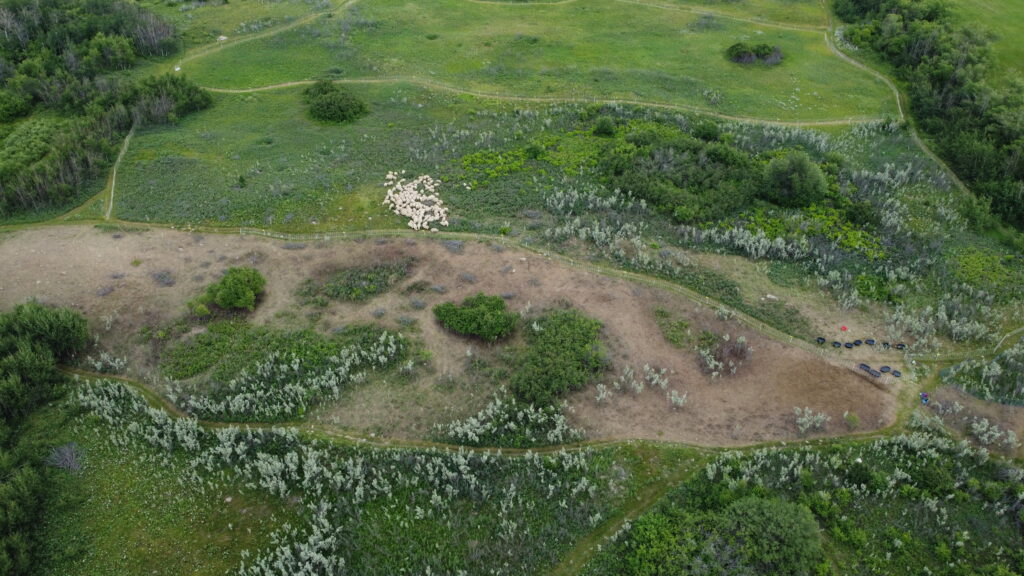
To truly appreciate why landowners are stepping up to manage fire together, we must look deeply at the ecology of the system. Historically, North American grasslands were shaped by two intertwined, dynamic forces: fire and large-herbivore grazing. Modern conservation science defines this powerful synergy as pyric-herbivory, the interactive feedback loop where livestock and wildlife are preferentially attracted to recently burned patches due to high-quality, nutrient-dense regrowth. This concentrated grazing pressure subsequently spares unburned patches, creating a continuously shifting mosaic of diverse habitats across the landscape.
This spatial heterogeneity is known as pyric diversity. Research led by plant ecologists such as Dr. Eric Lamb highlights how pyric diversity directly supports native flora, soil microbial communities, and grassland fauna by providing a wide array of successional stages within a single pasture or management unit (Lamb, 2023). Rather than treating a landscape uniformly, the introduction of structural complexity benefits everything from soil health to grassland bird populations.
Pyric-Tourism and Collaborative Training
As prescribed fire gains traction as a sophisticated land management tool, it is also sparking novel socioeconomic opportunities for rural regions. Communities are beginning to explore pyric tourism; educational and agritourism initiatives that invite the public, students, and agricultural stakeholders from all over the prairies to witness ecological restoration safely in action. By demystifying the fire process through guided field tours, live demonstrations, and public workshops, pyric tourism transforms a historically feared element into an engaging, community-celebrated feature of rural heritage.
Furthermore, academic institutions, extension programs, and specialized regional networks, drawing on collaborative insights from researchers, are helping formalize training frameworks across the prairies. Through in-person and online courses at the Lakeland College and University of Saskatchewan respectively These training programs ensure that safety standards, traditional ecological knowledge, and modern fire science walk hand in hand.
Conclusion
The journey from ditch to ditch is ultimately about connection. It connects fragmented habitats, links cutting-edge scientific research with practical land stewardship, and binds rural neighbors together in a common, purposeful goal. By embracing tools like pyric herbivory, participating in practical training networks like TREX, and leaning on the expertise of regional researchers and practitioners, prairie communities are proving that fire is not an end, but a vital beginning.
References
Elder, B. (2025). Community-engaged fire stewardship and capacity building on the Canadian Prairies. Prairie Conservation Journal, 41(2), 45–58.
Grilz, R. W. (2026). Faces of fire: Meeting the people behind the prescribed fires. Canadian Prairies Prescribed Fire Exchange. https://www.grasslandfire.ca/faces-of-fire
Gross, D. (2023). Applications of and barriers to prescribed fire for grassland management in Saskatchewan (Doctoral dissertation, University of Saskatchewan). Department of Plant Sciences.
Gross, D., & Romo, J. T. (2010). Spatial and temporal effects of burning on plant community characteristics and composition in a Fescue Prairie. Journal of Vegetation Science / University of Saskatchewan Research Publications.
Lamb, E. G. (2023). Seasonality and bacterial community assembly processes dominate prairie ecosystem service disruption during invasion. Soil Biology and Biochemistry, 184, 109120. https://doi.org/10.1016/j.soilbio.2023.109120
Lamb, E. G., Siciliano, S. D., & Fajana, H. (2023). Ecological disturbance in terrestrial ecosystems: Assessing the impact of pyric herbivory on soil ecosystem services in rough fescue grasslands. Journal of Applied Ecology, 60(4), 712–725.
Thank you to Tobi Oyedele for submitting the article and photos.
Photo credits by Renny Grilz, Pag
Photo 1: Pyric Herbivory at its best at the Saskatoon Natural Grasslands)
Photo2: Recently concluded prescribed fire