A Message from Ag-West Bio’s Interim CEO, Mike Wonnick | June 2026
July 7, 2026
Let’s Make Saskatchewan the MOST COMPETITIVE Place to Start and Scale an Ag-Bioscience Company
Over the last decade we’ve heard a lot about the need for more competitiveness and investment attraction in all sectors of the Canadian economy. We all agree on the issue, yet it is a challenge that requires many well-coordinated steps to a solution. I would like to propose a Saskatchewan-focused plan for commercializing Ag-Bioscience (Ag-Bio) innovation. This approach has the potential to form the template for wider sector improvement in Saskatchewan and Canada, if applied to other areas and to other industries.
Risk taking and entrepreneurship is the fuel for a country’s economic engine. A flourishing startup ecosystem creates jobs, attracts investment, encourages collaborating hubs of innovation and offers a growing environment for retaining the best and brightest new companies. Unfortunately, in Saskatchewan and Canada, the pace of entrepreneurial activity has been slowing. Leaders Fund recently reported that “The U.S. went from producing 11 times more high-potential startups than Canada in 2015, to 45 times more in 2024.”
The challenge is no longer a lack of ideas, capital, or infrastructure – it is a lack of alignment, coordination, and a seamless path to scale.
Saskatchewan is the best environment in the world for Ag-Bio Development!
- Saskatchewan is blessed with an abundance of resources second to none in food, fuel, fertilizer, diversity of crops, ecosystems, and production at scale. We have the hardest working and most industrious labour force in a cost-effective and business friendly environment.
- Saskatchewan has an outstanding agricultural research environment. This is supported by an effective Ag-Bio ecosystem that includes all levels of government, education institutions, physical infrastructure, and life sciences companies that offer a complete set of support resources to fully incubate, educate, support, mentor and commercialize idea development.
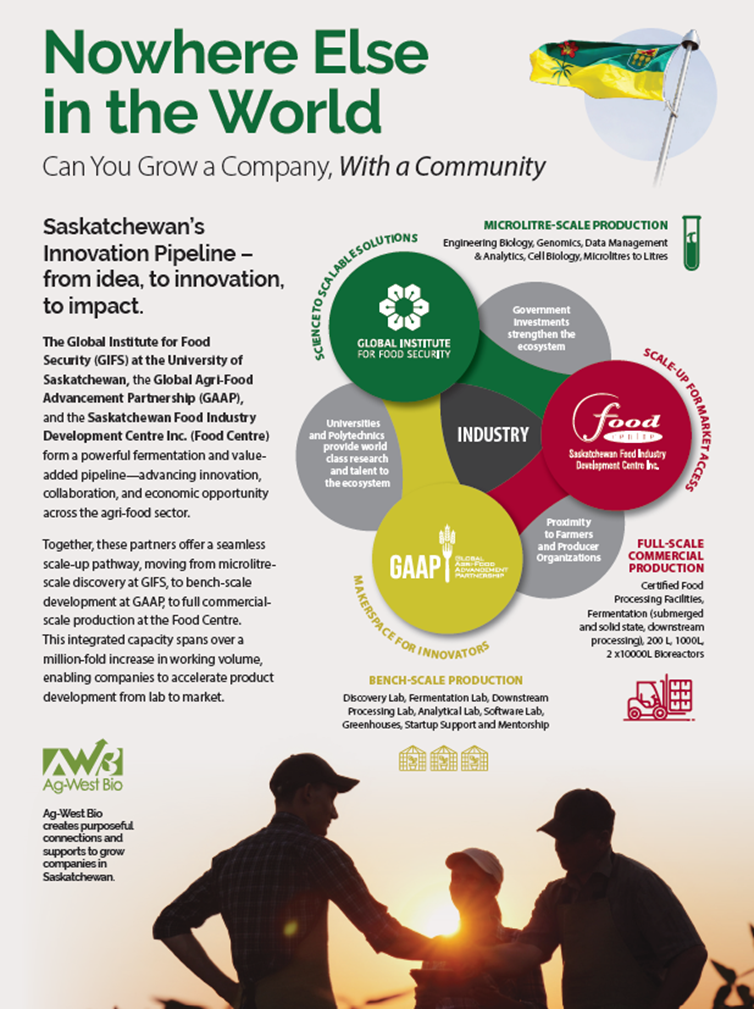
- Saskatchewan has a globally unique “Innovation Pipeline” that moves molecular Ag-Bio research through the lab to bench scale and into commercial level testing and production. This is accomplished by partnerships with the Global Institute for Food Security, the Global Agri-Food Advancement Partnership (GAAP), the Food Center and supported by Ag-West Bio (See Graphic 1). This is only one great example of our Saskatchewan advantage!
- Our connectedness is one of our strengths. Our small size is an advantage, allowing us to collaborate and convene the necessary resources quickly to help start and scale companies like nowhere in the world. We have an unsurpassed “get it done” and “problem solving approach”. We are committed to the greater economic good of the province and the country. We work together and celebrate the success of every company as they grow.
- Through our ecosystem and Ag-West Bio we have an outstanding suite of services of entrepreneur supports. Through existing partnerships, like our Innovation Pipeline, as well as the accelerators, cohorts, mentorship programs, capital funders, research agencies and business supports – we help the Ag-Bio industry progress rapidly through the business and growth issues they face.
But unfortunately, this is not enough. This is a competitive global market, and we need to stand out. At the same time, the Ag-Bio industry has a longer commercialization timeline and needs more patient and extended capital. This patience is something we need to double down on. We also need our entrepreneurs focused on their businesses – not spending precious hours navigating a system that is supposed to support them.
Saskatchewan can be Canada’s leader in the Ag-Bio industry – one that stands as an example to other sectors. Saskatchewan is uniquely positioned to serve as Canada’s test case for building the most effective, entrepreneur-first commercialization system in the world, and the Government of Saskatchewan has demonstrated its commitment to this through its 2030 Growth Plan. The goal is not to create new programs, but to better align and integrate what already exists into a coordinated, entrepreneur-focused system that reduces friction, accelerates decision-making, and improves outcomes. If we can do this in ag-bioscience, one of the most complex and capital-intensive sectors, we can create a model that scales across industries and jurisdictions.
At the centre of this approach is a shift in focus from programs to the entrepreneur journey. Specifically:
- Design around the entrepreneur journey: Measure success by how quickly and effectively a company can move from concept to scale — not by the number of programs, funding allocated, or activities delivered. Align incentives across organizations to reduce duplication and accelerate progress.
- Advocate for a predictable time-bound regulatory pathways for agri-food innovation: While the Ag-Bio industry naturally has a longer commercialization timeline and needs more patient and extended capital, there are steps we can take to streamline the regulatory roadblocks.
- Think of the entrepreneur’s experience: Continue to use the many benefits outlined above and work even harder as a team to put startups first. Collaborate as an ecosystem and convene the necessary resources for the success of the startup or the growing Ag-Bio Science company.
- Accept risk as part of the process: Celebrate the success of growing Ag-Bio companies and encourage those that come up short to get back in the race and try again.
- Build relationships that build businesses: Grow entrepreneur supports, entrepreneur in residence programs, bring founders to the table and invest in future leaders.
-
- Reward risk and scale outcomes through targeted, competitive incentives: Enhance and align existing programs (e.g., Saskatchewan Technology Startup Incentive) to better support scale-up, not just early-stage activity.
-
- Introduce capital gains exemptions or equivalent tax incentives tied to company growth and scaling in Saskatchewan.
-
- Adopt a ‘buy Saskatchewan innovation’ approach – enabling tax advantages or procurement preferences for local technology adoption.
- Deepen the capital pool: Bring a wider cooperative capital pool together to help companies start, grow and scale. FCC, Canadian Startup Capital Association and others, are doing great work with their partners currently in this area and provides a positive template towards success.
The opportunity is in front of us and the time is now. When resources and assistance align, there is unlimited potential and possibility!
GRAPHIC 1 – Open image